Curuan is a Barangay of Zamboanga City within Zone IX in the Zamboanga Pensinsula, Mindanao, Philippines.
>>> Click to go to the links of the 98 Barangays
While Google may show that Curuan is in Zamboanga del Sur, this is an uncorrected government error. Zamboanga City is an independent chartered city.
Curuan
Area in Hectares: 1,003.5189
Population (2020 Census): 11,954
Population (2015 Census): 8,796
Annual Growth Rate (2015-2020): 6.67%
Curuan, on the orther side of the mountain
Located on the east coast of Zamboanga City, Curuan is about 50 kilometers from the city proper. It borders the barangay of Quiniput to the south and Buenavista to the north.
Curuan is the largest barangay in Zamboanga City, covering an area of over 7,216 hectares (72.16 square kilometers), with dimensions of approximately 6 by 12 kilometers. As a school district seat, it manages 19 other barangays. Its elementary school alone has an enrollment of about 1,400 students.
As one drives down the highway and approaches the Curuan border, rice fields become visible on both sides. While primarily a farming community, Curuan is steadily modernizing its commercial center.
The barangay also has a large fishpond industry, with most fishponds located near the estuary, where mangroves once thrived. Unfortunately, people continue to cut the mangrove trees to sell them as fence posts, a practice that threatens the area’s natural resources. This must be addressed to preserve the environment.
Providing irrigation to hundreds of hectares of rice fields in both the Curuan and Quiniput areas, the Curuan River is a vital resource for the community.
By a beloved residence of Curuan
- You start your journey from Zamboanga City proper going east to Curuan on a car, you will pass by many, many barangays along the Maria Clara Lobregat highway. You will not get bored on this long trip as this highway will provide you the challenge and entertainment. Most Public Market are built along the highway. In fact some business stalls are on top the road. Vendors and buyers alike are doing their daily business with little concern on passing cars.
- Driving on this road requires good concentration not only because of unconcern pedestrians but because of reckless drivers of pedi-cabs, motorcycles, tricycles, cars, vans, not to mention big buses and trucks zooming on all sides and on every directions. But its not continuous as this condition only happen where every Public Market exist. Traffic would slow down near Bolong Barangay but road would start ascending and zig-zaging to Lubigan Barangay.
- Somewhere on this road you can stop and take a glimpse of a beautiful valley down below. Savor the scenery for a while. On your left, are mountain ranges, full of trees down to the foot of the mountain then coconut trees are neatly lined up that seems to follow the contour of the land to the edge of rice paddies. An open field with hues of greens,yellows and browns of various rectangularity. On your right is the fish pond area that appears brownish black with puddles of grayish water. It is enclosed by mangrove trees which snaked the shorlines of the sea. What a sight to behold but you have to continue your journey because somewhere down that marvelous landscape is Curuan.
- A few more kilometers you will be there. But these few kilometers might be your most challenging of them all as it is narrow, continuously descending, winding, and blind curves are common occurrence. Some curves you have to stop completely to let the other incoming car to pass by first. Do not look down on your right shoulder if you have acrophobia. But all will be okay with careful driving. After a few minutes of descending you will hit the first flat road. A very welcome relief but it is not yet Curuan, but Quiniput Barangay.
- At this point you can relax and casually cruise until you come to open space of rice field and on the center of this open space, a cluster of houses, buildings and busy with lives then you can rest assure you are on the threshold of wonderland of Curuan. A barangay situated and surrounded by mountains from the north to the west and to the south and with an opening to the east facing the sea. Topographically or imaginary aerial view these mountains form a big capital letter “C” and within that letter C, flourished a humble, proud barangay called “CURUAN”.
- by: Amadeo Ledesma
History of Curuan, Zamboanga City
Long before the arrival of the Spaniards in Zamboanga City, Curuan was already a well-established settlement. The inhabitants were primarily Muslims, with the Sama people living along the riverbanks toward the interior and the Yakans residing along the coast at the mouth of the Curuan River. Fishing was their main source of livelihood.
It is said that these early inhabitants were very religious and often passed the time reading the Quran. When the Spaniards arrived, the first man they encountered was reading a book. When asked for the name of the place, the man, thinking he was being asked for the name of the book, replied, “Quran.” The Spaniards mistook this for the name of the settlement, and from that day forward, the place was named “Curuan,” a derivation of the word “Quran.”
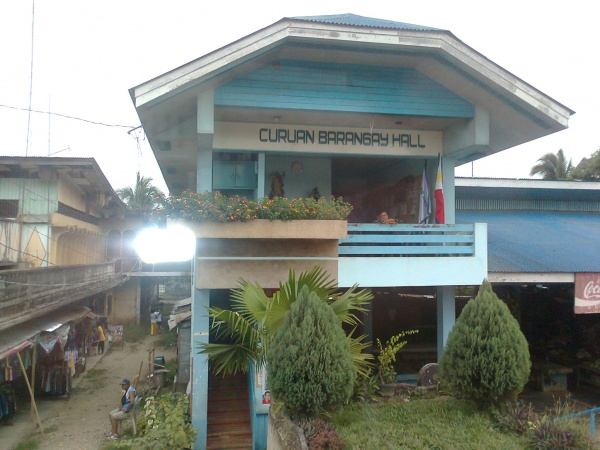
Elected Government Officials of Curuan, Zamboanga City
- Elected Officials of Curuan for the term of 2018 – 2020
- Punong Barangay Chairman/Captain : Noel Balber Perez
- Barangay Kagawads/Councilors:
- Joselito Atilano Falcasantos
- Ronel Pajarto Perez
- Ronaldo Tee Angeles
- Jhon Marc Falcsantos Adil
- Harold De Leon Baco
- Delia Dela Cruz Garcia
- Carmelito Falcasantos Manalo
- Elected Officials of Curuan for the term of 2013-2016-18
- Punong Barangay Chairman/Captain : Perez, Noel Balber
- Barangay Kagawad Angeles, Rommel Natividad
- Barangay Kagawad Manalo, Carmelito Falcasantos
- Barangay Kagawad Rosal, Jose Bazan
- Barangay Kagawad Adil, Aksa Igasan
- Barangay Kagawad Paragas, Danilo Jumawan
- Barangay Kagawad Angeles, Ronaldo Tee
- Barangay Kagawad Falcasantos, Joselito Atilano
- Elected Officials of Curuan for the term of 2010-2013
- Curuan, Barangay Chairman, Noel B. Perez
- Curuan, Kagawad 1, Rommel Faustino N. Angeles
- Curuan, Kagawad 2, Nelson T. Carroz
- Curuan, Kagawad 3, Erolino F. De Los Reyes
- Curuan, Kagawad 4, Jefferson J. De Los Reyes
- Curuan, Kagawad 5, Danilo J. Paragas
- Curuan, Kagawad 6, Benjamin B. Tabamo Jr.
- Curuan, SK Chairman, Sean Vergel F. Altea
- Elected Officers for the term of 2007 – 2010
- Punong Barangay or Barrio Captain: Carmelito F. Manalo
- Barangay Kagawad:
- Nelson T. Carroz
- Noel B. Perez
- Jefferson J. De Los Reyes
- Danilo J. Paragas
- Melvin T. Quintos
- Benjamin B. Tabamo Jr.
- Rommel N. Angeles
- Secretary: Delica D. Garcia
- Treasurer: Juliet S. Heresilles
- SK Chairman: Krysthalane G. Carroz
- SK Kagawad:
- Janice Renzy S. Rarugal
- Cherry Mae G. Angeles
- Julius C. Bucoy
- Claridel A. Garcia
- Reshimie P. Gallardo
- Charmelyn Jane Guevarra
- Crisjay D. Tabar
- Curuan has its own Police force extension. In addition to the Police force, there is also an army detachment in a place called “Sampaloc” for the security of the barangay.
Navigate to the 98 Barangays of Zamboanga City
98 Barangays of Zamboanga City within Region 9 – Mindanao in the Republic of The Philippines
Arena Blanco-D2 ● Ayala-D1 ● Baliwasan-D1 ● Baluno-D1 ● Boalan-D2 ● Bolong-D2 ● Buenavista-D2 ● Bunguiao-D2 ● Busay-D2 ● Cabaluay-D2 ● Cabatangan-D1 ● Cacao-D2 ● Calabasa-D2 ● Calarian-D1 ● Camino Nuevo-D1 ● Campo Islam-D1 ● Canelar-D1 ● Capisan-D1 ● Cawit-D1 ● Culianan-D2 ● Curuan-D2 ● Daap ● Dita-D2 ● Divisoria-D2 ● Dulian Bunguiao-D2 ● Dulian Pasonanca-D1 ● Guisao-D2 ● Guiwan-D2 ● Kasanyangan-D2 ● La Paz-D1 ● Labuan-D1 ● Lamisahan-D2 ● Landang Gua-D2 ● Landang Laum-D2 ● Lanzones-D2 ● Lapakan-D2 ● Latuan Curuan-D2 ● Licomo-D2 ● Limaong ● Limpapa-D1 ● Lubigan-D2 ● Lumayang-D2 ● Lumbangan-D2 ● Lunzuran-D2 ● Maasin-D1 ● Malagutay-D1 ● Mampang-D2 ● Manalipa-D2 ● Mangusu-D2 ● Manicahan-D2 ● Mariki-D1 ● Mercedes-D2 ● Muti-D2 ● Pamucutan-D1 ● Pangapuyan-D2 ● Panubigan-D2 ● Pasilmanta-D2 ● Pasobolong-D2 ● Pasonanca-D1 ● Patalon-D1 ● Putik-D2 ● Quiniput-D2 ● Recodo-D1 ● Rio Hondo-D1 ● Salaan-D2 ● San Jose Cawa-Cawa-D1 ● San Jose Gusu-D1 ● San Ramon-D1 ● San Roque-D1 ● Sangali-D2 ● Sibulao Curuan-D2 ● Sinubung-D1 ● Sinunuc-D1 ● Sta. Barbara-D1 ● Sta. Catalina-D2 ● Sta. Maria-D1 ● Sto. Niño-D1 ● Tagasilay-D2 ● Taguiti-D2 ● Talabaan-D2 ● Talisayan-D1 ● Talon-Talon-D2 ● Taluksangay-D2 ● Tetuan-D2 ● Tictabon-D2 ● Tictapul-D2 ● Tigbalabag-D2 ● Tolosa-D2 ● Tugbungan-D2 ● Tulungatung-D1 ● Tumaga-D1 ● Tumalutab-D2 ● Tumitus-D2 ● Victoria-D2 ● Vitali-D2 ● Zambowood-D2 ● Zone I-D1 ● Zone II-D1 ● Zone III-D1 ● Zone IV-D1
Picture Gallery of Curuan
Featured News of the Philippines
January 7, 2026
1️⃣ Andas for Traslación 2026 now ready, with upgrades
The Andas carrying the Black Nazarene for January 9 Traslación features new steering wheel and reinforced underchassis to handle massive devotee crowds safely.
2️⃣ Over 3,500 affected by Mayon volcano unrest
NDRRMC reports 3,515 people from 964 families evacuated in Albay due to recent magmatic eruptions, ashfall, and pyroclastic flows; all in permanent danger zone.
3️⃣ Magnitude 6.4 quake hits off southern Philippines
USGS detects 6.4 quake off Davao Oriental coast—no tsunami threat reported, but locals feel shaking; no immediate damage confirmed.
The barangay system is one of the best government systems in the world.

This is the “Barangay Code of the Philippines – PDF”.
 |
| A Barangay Clearance is NEEDED in order to get a Business License. So why is the barangay name not in most business addresses? Ask your Barangay Captain/Chairman to create a Resolution to make it mandatory to put the barangay name in all Business addresses. |
- Every Government Unit in the Philippines is within a Barangay. The municipal hall, city hall, the provincial capitol building, and even the Malacañang Palace where the president resides is within a Barangay.
The barangay has power and authority over its domain. The improvement of the barangay rests on the barangay officials. The barangay chairman, the barangay council and the local businessmen forge the prosperity of the barangay. Not the president of the Philippines, senate, nor congress. Not the governor of the province, not the mayor nor council of the municipality or city. Poor barangays stay poor because of weak and/or ignorant(uninformed) barangay leaders.
When roads or any infrastructure need to be built, improved or repaired, all the barangay officials have to do is make a resolution and present it to the city or municipality council. The resolution will force the city/municipal council or responsible government office to hear the legitimate demands. “The squeaky wheel gets the grease.”
- Each city or municipality is represented by the “barangay association or federation”. The elected president of the Association of Barangay Council and the President of Kabataan (SK) association each have a seat in the City/Municipality council. Their powers are the same and equal to the elected city/municipality councilors. They are there to help lobby the demands of the barangays. They are not there just to collect a big salary and rub elbows with the regular elected city/municipality council, but to also represent the needs of the barangays.
- The duties of the barangay officials are specifically written in Chapter III(Punong Barangay) and Chapter IV (The Sangguniang Barangay). Read it..PDF file
Practically anything that has to do with the barangay, the barangay officials have a say on it and most likely the authority over it. The majority of the barangay officials are not aware of their duties and power. They depend on the city council or mayor. The elected barangay officials are afraid of the mayor and city/municipality’s “Sangguniang Panlungsod”. They are in fear of being ousted or removed from office. The truth is, the “Sangguniang Panlungsod” does not have the power to remove or suspend any elected barangay officials from office. Only the COURT OF LAW can do this (judicial branch of the government). Elected public officials can’t be suspended by the DILG or the office of the president unless an official complaint has been filed, there must be proof and there must be due process. Republic Act 7160 chapter 4, Section 60 – pdf file. Information is power. Be informed. Do not be intimidated by the president, senator, congressman, governor, mayor, vice-mayor, or councilors. Do your job.
The control of traffic is not up to the city council or chief of police. It is controlled by the barangay. If the barangay needs traffic enforcers, the barangay can make a resolution to demand it from the city or municipality council. When the electric coop or the water district do not maintain their lines, the barangay can directly demand for the maintenance from the utility companies. No need to wait for city council.
The citizens also has the power to make demands to the barangay officials. In case the officials get blinded. Simply file an official complaint with the barangay secretary naming the Punong barangay as the respondent representing the barangay.
Barangay officials are paid to serve the public. So never be afraid to ask them to do anything if it is for the benefit of entire barangay. Even the SK officials are compensated specially the SK chairman.
- If the power lines are sagging, don’t go to the power company, go to the barangay office. Ask the barangay for a DEMAND resolution against the power company.
- If the water lines are busted, don’t wait for the water company, go to the barangay office. Ask the barangay for a DEMAND resolution against the water company.
- If the potholes in the road are not fixed, don’t wait for the The Department of Public Works and Highways (DPWH), go to the barangay office. Ask the barangay for a DEMAND resolution against the DPWH.
- Are you beginning to get the point?
Cleaning the shorelines, drainage systems, streets, rivers, and parks within your barangay is YOUR responsibility. You are accountable for this. It is not the responsibility of the City/Municipality officials. The citizens and officials of the barangay are responsible. Stop blaming others.
- BUDGET: As far as the preparation for the budget expenditures, it starts at the barangay level, then moves on to cities, municipalities, provinces and regions. The barangays need to exercise their authority. They need to put their yearly budget together for their administration and future projects. The majority of the barangays leave this job to the municipality and city. This is so wrong. Then when the budget doesn’t come or is lacking, they complain.
- The budget for the barangays does go to the City or Municipality, but simply for holding and later distribution. The city or municipality DOES NOT approve the budget. It was already approved by congress. The city or municipality simply “distributes” the approved budget.
- The bureau of internal revenue is in cahoots to subdue the barangays, municipalities and provinces. They call the rightful shares to the taxes collected as “Internal Revenue Allotment Dependency”. It is not a dependency. It is the lawful and rightful share of the LGU as specified in “TITLE III, SHARES OF LOCAL GOVERNMENT UNITS IN THE PROCEEDS OF NATIONAL TAXES, CHAPTER I, Allotment of Internal Revenue Taxes, Section 284.”
- “IMPERIAL MANILA IS A MYTH!”, it does not exist anymore. The Philippine budget formulation system is not centralized. “Budgetary planning has been DECENTRALIZED since 1991” – pdf file. It is the responsibility of each LGU to submit their budgetary needs for review. Failure to submit is the problem.
- DURING ELECTIONS: Where do City and Municipality politicians go to campaign? They seek the support of the Barangay officials. They plead to the barangay folks for the votes. Even the candidate for president. But after the election they ignore you. Do not ever forget the power of the barangay.
Ignorance keeps the pinoys thinking that Manila rules. Be informed, be educated and make your barangay prosper.
 Regional Senatorial Representation – Minimum of One Senator per Region
With the current state of affairs a candidate needs millions of pesos to be a senatorial candidate. Because his/her campaign must be nationwide and is only directed at the most populous cities and municipalities to guarantee the most votes. Plus the comelec is prejudiced in the acceptance of certificate of candidacy. How often have you witnessed the COMELEC declare a provincial senatorial candidate as a nuisance candidate. The comelec is in cahoots with the big time money makers in the metro manila area. Unless the provincial candidate has millions of pesos and big time connections, his/her chance for even being accepted by the COMELEC is hopeless.
The majority of Barangay Captains still think that the mayor is the boss. Wrong!