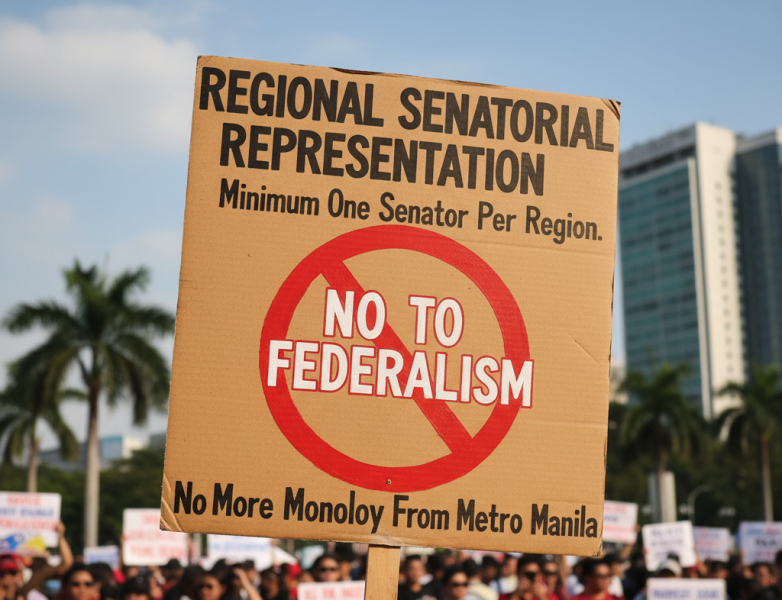
Regional Senatorial Representation – Minimum of One Senator per Region
With the current state of affairs a candidate needs millions of pesos to be a senatorial candidate. Because his/her campaign must be nationwide and is only directed at the most populous cities and municipalities to guarantee the most votes. Plus the comelec is prejudiced in the acceptance of certificate of candidacy. How often have you witnessed the COMELEC declare a provincial senatorial candidate as a nuisance candidate. The comelec is in cahoots with the big time money makers in the metro manila area. Unless the provincial candidate has millions of pesos and big time connections, his/her chance for even being accepted by the COMELEC is hopeless.
No to Federalism in the Philippines
The Philippines is now officially divided into 18 administrative regions, each with its own cities, municipalities, and provinces:
Luzon – 8 regions
Region I – Ilocos Region ● Region II – Cagayan Valley ● Region III – Central Luzon ● Region IV‑A – CALABARZON ● MIMAROPA Region (Region IV‑B) ● Region V – Bicol Region ● NCR – National Capital Region ● CAR – Cordillera Administrative Region
Visayas – 4 regions
Region VI – Western Visayas ● Region VII – Central Visayas ● Region VIII – Eastern Visayas ● NIR – Negros Island Region (re‑established in 2024)
Mindanao – 6 regions
Region IX – Zamboanga Peninsula ● Region X – Northern Mindanao ● Region XI – Davao Region ● Region XII – SOCCSKSARGEN ● Region XIII – Caraga ● BARMM – Bangsamoro Autonomous Region in Muslim Mindanao
Each region is already represented in the House of Representatives — every province and every chartered or independent city has its own congressional representative.
However, the Senate does not represent the regions. Senators are elected nationally, just like the President and Vice President.
The Representation Problem
As of the 20th Congress (2025–2028), the Senate is still dominated by Luzon-based politicians, especially from Metro Manila. The imbalance is striking:
Luzon: 17 senators (NCR alone has 12)
Visayas: 2 senators
Mindanao: 5 senators
That means 11 of the 18 regions have no senator at all.
Why This Matters
The lack of regional representation means far‑flung provinces and barangays are often ignored. Senators do not depend on their home region for re‑election — they only need the national vote, which pushes them to focus on the most populous areas, especially Metro Manila. Many even establish a “permanent” residence in NCR, further disconnecting them from their roots. To ensure genuine representation, senators should be required to maintain their primary residence in the region they represent, strengthening their accountability to local constituents and keeping them attuned to the unique needs of their home communities.
A Better System: Minimum of One Senator per Region
Imagine if each of the 18 regions had at least one senator.
Mindanao’s 6 regions would each have a dedicated voice.
Senators would be accountable to their regional voters, not the entire nation.
Campaign costs would drop dramatically, making it possible for capable leaders without massive funding to run.
COMELEC could no longer easily dismiss provincial candidates as “nuisance” contenders.
The Two legal methods to amend the Constitution
| Method | How it starts | Vote requirement | Final step |
|---|---|---|---|
| Constituent Assembly (Con‑Ass) | Congress itself proposes amendments | 3/4 vote of all members of Congress, voting separately by House and Senate | Ratification by majority in a nationwide plebiscite |
| Constitutional Convention (Con‑Con) | Congress passes a law calling for a convention; delegates are elected to draft amendments | Majority vote in Congress to call the Con‑Con | Ratification by plebiscite |
How It Would Work
Senators elected by region — not nationwide.
Minimum of one senator per region, with additional seats based on population.
Only the President and Vice President would be elected nationally.
Governors, congressmen, mayors, and councilors would still be elected at the provincial or municipal level.
This would flatten the power structure and ensure that regional issues are addressed in the national conversation.
Current Regional Representation (2025)
Luzon – 17 Senators (5 of 8 regions represented)
Region I (Ilocos): Imee Marcos
Region III (Central Luzon): Joel Villanueva, JV Ejercito, Lito Lapid
Region IV‑A (Calabarzon): None
Region IV‑B (MIMAROPA): None
Region V (Bicol): Francis Tolentino
NCR: Nancy Binay, Pia Cayetano, Alan Peter Cayetano, Risa Hontiveros, Grace Poe, Jinggoy Estrada, Bong Revilla, Cynthia Villar, Sherwin Gatchalian, Bam Aquino, Mark Villar, Loren Legarda
Region II (Cagayan Valley): None
CAR: None
Visayas – 2 Senators (2 of 5 regions represented)
Region VI (Western Visayas): None
Region VII (Central Visayas): None
Region VIII (Eastern Visayas): None
Negros Island Region (NIR): None
Region VI–VIII combined: Only historical representation; currently underrepresented.
Mindanao – 5 Senators (3 of 6 regions represented)
Region X (Northern Mindanao): Migz Zubiri, Koko Pimentel
Region XI (Davao Region): Bong Go, Ronald “Bato” dela Rosa
Region XII (SOCCSKSARGEN): Alan Peter Cayetano (born in Taguig, but political roots in Sarangani)
BARMM, Caraga, Zamboanga Peninsula: No current senators
Current Senators of the Philippines (2025) and Regions of Origin
Currently our senators don’t care, they are not held accountable locally.
Let us make the senators accountable for their actions or inability to prosper the nation. With the current political structure the senators think they are immune. Once elected they only think of the capital region of the Philippines. If the senate members are elected from the each of the 17 regions of the Philippines, they will think twice about not properly representing their region.
If they do not represent the region properly they will not be re-elected. They can’t get support anywhere else. A senator from Iloilo can’t campaign to the people from Cebu for support. Each regional senator to his own region. Accountability will help control the beast.
Do these Senators care about Tungawan, Zamboanga Sibugay? It is highly doubtful.
Bam Aquino – NCR (Luzon)
Alan Peter Cayetano – NCR / Region XII roots (Mindanao)
Pia Cayetano – NCR (Luzon)
Ronald “Bato” dela Rosa – Region XI (Mindanao)
JV Ejercito – Region III (Luzon)
Francis Escudero – Region V (Luzon)
Jinggoy Estrada – NCR (Luzon)
Sherwin Gatchalian – NCR (Luzon)
Bong Go – Region XI (Mindanao)
Risa Hontiveros – NCR (Luzon)
Lito Lapid – Region III (Luzon)
Loren Legarda – NCR (Luzon)
Imee Marcos – Region I (Luzon)
Grace Poe – NCR (Luzon)
Koko Pimentel – Region X (Mindanao)
Robin Padilla – NCR/Mindanao roots
Nancy Binay – NCR (Luzon)
Bong Revilla – NCR (Luzon)
Francis Tolentino – Region V (Luzon)
Joel Villanueva – Region III (Luzon)
Mark Villar – NCR (Luzon)
Cynthia Villar – NCR (Luzon)
Migz Zubiri – Region X (Mindanao)
[Vacant/Next Elected Seat]
Minimum of One Senator per Region is Better than Federalism
Many overlook the fact that the Philippines, under its unitary form of government, remains one of the fastest-growing economies in the world. We have been recognized as one of the best countries for investment, with GDP growth sustained over the past decade and infrastructure development scaled up nationwide.
Even the poorest regions, which spend more than they generate, have been steadily improving thanks to capital infusion from the national government. If we were under a federal system, these regions would struggle to survive.
Four Regions Generate 61.7% of the Philippines’ GDP
According to 2024 GDP data:
| Rank | Region | % of National GDP |
|---|---|---|
| 1 | NCR (National Capital Region) | 31.1% |
| 2 | Region IV‑A (CALABARZON) | 14.1% |
| 3 | Region III (Central Luzon) | 10.9% |
| 4 | Region VII (Central Visayas) | 5.6% |
These four regions alone account for 61.7% of the country’s GDP. Under federalism, they would keep most of their earnings, leaving poorer regions without the current level of national support.
The Bangsamoro Federalism Agenda
Zamboanga City has long opposed inclusion in the ARMM/BARMM, but federalism has tempted some to accept a Bangsamoro state in exchange for their own. This is federalism greed — and it plays directly into the Bangsamoro agenda.
The BARMM already enjoys autonomy, governs itself, and receives over ₱80 billion annually. Yet some Moro leaders still push for a permanent Bangsamoro State under federalism — one that cannot be dissolved and could eventually secede.
The Historical Truth About Bangsamoro’s Origins
The claim that Bangsamoro are the original inhabitants of Mindanao, Sulu, and Palawan is false.
Moros are Muslims — followers of Islam — and arrived in the Philippines in 1380.
Before that, the islands were inhabited by indigenous peoples with their own governance, languages, and beliefs.
Conversion to Islam did not make Muslims the original owners of the land.
Shari’ah Law and the Federalism Trojan Horse
The BBL explicitly states that Shari’ah law shall have supremacy over Muslims in Bangsamoro territory. This merges religion and government, violating the constitutional separation of church and state.
Federalism would spread Shari’ah courts and the NCMF to every state, embedding Islamic governance structures nationwide.
A Unique Global Case
The Philippines is the only majority-Catholic country with multiple national laws favoring and financing Islam — including exclusive land grants, the NCMF, Hajj funding, and madrasah support.
It even operated a government-run Islamic TV channel, Salaam TV, from 2017 until its closure in September 2023, replaced by the TeleRadyo Channel of Radyo Pilipinas 1.
Final Word: Minimum of one senator per region is a fair, constitutional, and unifying reform.
We understand how to navigate legal systems .
Site about law, jurisprudence, and legal practice:
Law, first of all, gives people certainty. When rules are clear and enforceable, individuals and businesses can plan their actions without guessing tomorrow’s consequences. Contracts become meaningful, property becomes secure, and agreements stop being acts of trust alone. Law turns uncertainty into structure, allowing society to function beyond personal relationships and verbal promises.
The second role of law is protection — against abuse, arbitrariness, and imbalance of power. Legal systems exist to ensure that rights are not dependent on strength, status, or connections. Through courts, procedures, and legal remedies, the law creates mechanisms to resolve conflicts peacefully and fairly, even when interests collide. In a changing world, this protection becomes a stabilizing force rather than a formality.
Finally, law shapes the way people think and act. Legal awareness encourages responsibility, critical thinking, and long-term perspective. People learn to evaluate consequences, respect boundaries, and defend themselves with arguments rather than force. As a result, law provides not only legal certainty, but also confidence in institutions — and in the future built on rules rather than chaos.